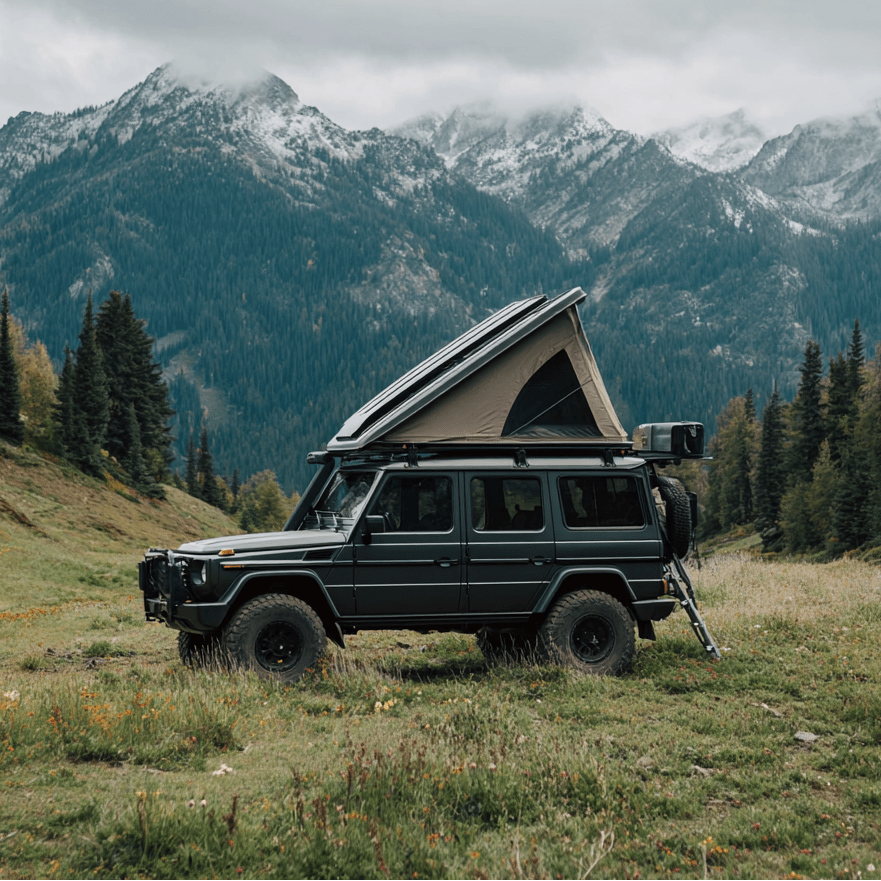
Overlanding is simple at its core: you travel by vehicle, live out of what you can carry, and sleep wherever the road (or dirt track) lets you stop. Your rooftop tent becomes your bedroom in all of it—whether you’re solo chasing quiet horizons or packing kids and dogs for a long weekend. That’s why design quality and durability matter so much. A well-built rooftop tent doesn’t just look good on your rig; it keeps you dry in storms, stable in high winds, and comfortable for years of trips instead of a season or two of struggle.
Step 1: Choose the Right Vehicle for Your Overlanding Style
You don’t need a six-figure build to start overlanding. You do need a vehicle that realistically matches where you want to go and how you want to travel.
Here’s what matters most:
Ground Clearance & Drivetrain
-
Higher clearance helps you clear ruts, rocks, and washouts.
-
4WD or AWD is strongly preferred if you plan to explore unmaintained roads, forest tracks, desert two-tracks, or snowy mountain passes.
If you’ll stick mostly to graded dirt roads with occasional rough sections, a practical SUV or wagon on good all-terrain tires can be plenty capable. If you want to chase remote passes and technical trails, you’ll want 4WD, low range, and solid recovery points.
Step 2: Hard Shell vs. Soft Shell Rooftop Tents
Next choice: what kind of rooftop tent should you run?
Rooftop tents generally fall into three camps: hard shell, soft shell, and hybrids.
Hard Shell Rooftop Tents
Hard shells use a rigid top and/or bottom (often aluminum or fiberglass) with fabric walls that pop up or cantilever open.
Why people love them:
-
Fast setup and takedown—often under a minute
-
Better aerodynamics on the highway
-
Excellent weather protection and durability
-
Bedding often stays inside when closed
Soft Shell Rooftop Tents
Soft shells fold open like a clamshell and are covered with a heavy fabric travel cover when closed.
Why people choose them:
-
Often more space per dollar than hard shells
-
Big annex and awning options for gear, pets, or getting dressed standing up
-
Classic “overland camp” aesthetic
The Real Decision: How You Travel
Here’s the honest short version:
-
If you’re moving almost every day and value speed, simplicity, and longevity → hard shell or hybrid.
-
If you want maximum square footage and annex space at a more approachable price → soft shell.
Either way, you’re bolting a bedroom to your roof. This is not where you go “cheap enough.”
Step 3: Why Durability and Design Are Worth the Price
The rooftop tent market is booming because people want convenience, mobility, and comfort. That growth also means the quality bar is rising: overland consumers increasingly value gear that’s durable and efficient, not disposable.
Here’s the hard truth: You can absolutely find rooftop tents that are cheaper on paper but you’ll usually pay for it in frustration, leaks, or a shortened lifespan.
Durability is about more than just “thick fabric”:
-
Frame & hinge design – does it feel solid when you climb in, or flexy and creaky?
-
Hardware & fasteners – stainless vs. mystery metal, proper brackets vs. flimsy stamped parts.
-
Floor & shell construction – insulated panels, reinforced corners, robust seals.
-
Thoughtful design details – storm flaps, covered zippers, tie-down points that make sense.
If you want extra interior space—for taller sleepers, restless kids, or enough room for your beloved dog—buying a tent that’s better engineered is almost always worth the bump in price. Oversized RTTs that are poorly designed put more stress on hinges, gas struts, and fabric and can age quickly under real-world use.
Comfort is negotiable.
Durability is not.
Step 4: Original Brands vs. White-Labeled Tents
Let’s talk about the elephant in the rooftop-tent room: white labeling.
The overlanding boom has created huge demand for RTTs. However, that demand pulled in many companies that don’t design or engineer tents and simply buy a generic factory tent, add a logo, and call it a “new” brand - a practice is called white-labeling.
Is that always evil? No. Sometimes the base product is decent. But as a customer, you deserve to know what you’re paying for.
Why Supporting Original Manufacturers Matters
When you choose a rooftop tent from a brand that actually designs and manufactures its own gear—think of companies like Intrepid Camp Gear & 23ZERO and other true builders—you’re doing more than buying a product:
-
You’re funding R&D, prototyping, and real-world testing that pushes the category forward.
-
You’re rewarding innovation, not just marketing.
-
You’re helping create a healthier ecosystem where quality and originality are what win.
These original manufacturers know their products inside and out: the materials, the stitching patterns, the weak points they improved between generations. That usually translates directly into:
-
Better long-term durability
-
More responsive customer service
-
Stronger warranties and access to replacement parts
-
Ongoing product refinements based on real feedback
White-labeled brands, on the other hand, may not have deep product knowledge—because they didn’t build the tent. If something goes wrong, support can be slower, more generic, or limited to whatever the factory offers.
Step 5: How to Spot a Real Rooftop Tent Brand (And Why We’ve Already Done It for You)
If you wanted to do all the homework yourself, finding a true rooftop tent manufacturer (not just a white-labeled clone) would look something like this:
-
Deep-dive their story: Read the “About” page and product pages for signs of real design work—talk of in-house engineering, prototypes, testing, and manufacturing… not just “we love the outdoors.”
-
Compare the hardware, not just the logo: Look closely at shells, ladders, hinges, and windows across different brands. If everything looks identical with different badges, it’s probably the same generic tent underneath.
-
Check long-term feedback, not just ads: Dig through forums, Reddit threads, overland groups, and YouTube for multi-trip, multi-year reviews that talk about leaks, failures, warranty claims, and parts support.
You can do all of that. Many people do—and it can take days, weeks, even months of scrolling, bookmarking, and second-guessing.
The good news?
At Sky Camp Supply, this deep research is the starting line, not an afterthought. Our rooftop tent collection is built around original brands and true manufacturers only—companies that actually design, build, and stand behind their own gear.
At Sky Camp Supply, the quality of each product is the foundation of our brand: every piece is selected for its beauty, resilience, and thoughtful design. Whether it’s your backyard or the backcountry, we make it possible to sleep beautifully outside.
How Sky Camp Supply Curates Rooftop Tents (So You Don’t Have To)
Here’s the good news: you don’t have to do all of this homework alone.
At Sky Camp Supply, we intentionally don’t list every rooftop tent on the market. Instead, we focus on brands that:
-
Design and engineer their own products
-
Invest in durable materials and thoughtful construction
-
Stand behind their gear with real support and clear warranties
-
Share our belief that overlanding gear should be built to last, not just built to look good in a feed
That’s why our rooftop tent collection is built around original manufacturers, not generic white-labeled clones. The goal is simple: when you choose a tent from our lineup, you’re getting something we’d be confident sleeping in, hundreds of miles from the nearest hotel. We bring tents that are worthy of the miles you’re about to put on them.
The Bottom Line: Start Smart, Buy Once, Go Far
Overlanding doesn’t start with a perfectly built rig. It starts with a clear idea of how you want to travel and gear that’s honest about what it can handle.
If you:
-
Choose a realistic, reliable vehicle
-
Match it with a rooftop tent that fits its limits
-
Prioritize durability and original design over gimmicks
-
Take basic care of your setup
…you’ll get something more valuable than any “latest build” post: years of trips where your shelter simply works, letting you focus on the view, the quiet, and the road that keeps disappearing into the distance.
Ready to Build Your Rooftop Tent Setup?
If you’re at the point where you’re comparing hard shell vs. soft shell, counting ladder rungs in review photos, and squinting at hinge designs… you’re ready to start looking at specific tents.
Explore our curated Rooftop Tent Collection to see the original, high-quality manufacturers we’ve handpicked for Sky Camp Supply. Each model is chosen for its build quality, materials, and design decisions—so you can spend less time sorting through lookalikes and more time planning your first (or next) overland route.
0 comments